By Biswajit Dhar | Briefing Paper # 32 | January 21, 2020
On March 22, 2018, President Donald Trump signed the “Presidential Memorandum Targeting China’s Economic Aggression” signalling the beginning of a trade war between the two largest economies. President Trump initiated this action in exercise of the powers granted to his administration under Section 301 of the Trade Act of 1974. The Section 301 allows the Trade administration to initiate action against any country, which, in its view, violates intellectual property rights (IPRs) belonging to American firms. But,…
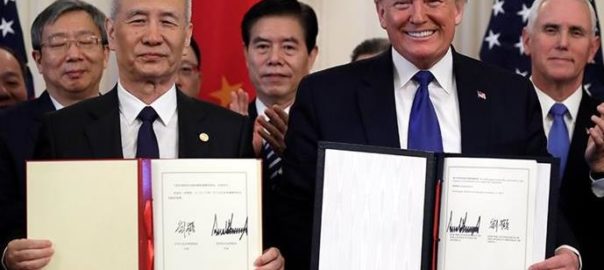
On January 15, the US President Donald Trump and Chinese Vice Premier Liu He signed a “phase one” trade agreement to de-escalate an 18-month trade war between the world’s two biggest economies. After months of tough negotiations and retaliatory trade actions, both countries agreed to proceed ahead with the “phase one” trade agreement. The core elements of the “phase one” trade agreement include intellectual property, technology transfer, agriculture, financial services, currency, and exchange rate policies. Besides, the deal establishes a…
By Biswajit Dhar | Briefing Paper # 31 | December 23, 2019
In November 2019, the Indian government took an unprecedented decision to withdraw from the Regional Comprehensive Economic Partnership (RCEP), which was to be the world’s largest economic integration agreement comprising 16 East Asian economies. The decision to withdraw came after almost all major domestic entities in both agriculture and manufacturing argued that the steep reductions in tariffs that were one of the main planks of RCEP would be detrimental to their interests.
India’s withdrawal from the Regional Comprehensive Economic Partnership (RCEP), the 16-country mega-regional trade agreement in East Asia and also the world’s largest trading bloc, must be seen as evidence that in India, strong voices from the stakeholders can make their impact felt on the government’s decision-making. Few realised that it was the first time in post-independence India, a cross-section of domestic constituencies, including farmers, trade unions, representatives of major sectors of Indian industry and civil society organisations, spoke in…
By Kavaljit Singh | Briefing Paper # 30 | November 6, 2019
On November 4, India announced its decision to exit the negotiations on the proposed Regional Comprehensive Economic Partnership (RCEP) – a mega-regional free trade agreement. Prime Minister Narendra Modi conveyed the decision at the third RCEP Summit that took place in Bangkok. The summit was attended by the leaders of all 16 RCEP Participating Countries (RPCs).
The full text of PM Modi’s address at the RCEP Summit is not yet available, but according to a tweet by Prasar Bharati (India’s…