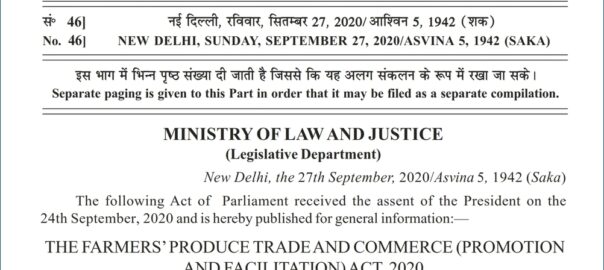
Two hurriedly enacted new farm laws do not throw up altogether new ideas. These so-called ‘reforms’ in agricultural marketing have been on the cards for much of the last two decades. Among other things, the emphasis two new central laws place on agricultural export and large players are not reformative. Unless global trade…
By Kavaljit Singh | Briefing Paper # 41 | September 19, 2020
India has become the world’s new hotspot of the Covid-19 pandemic as infection cases have surged in recent weeks. On September 7, India overtook Brazil with 4.2 million confirmed cases to become the country with the second-largest number of confirmed cases in the world. On September 16, the total number of confirmed cases surged past five million (Figure 1). If the current trend continues, India may soon become the world’s worst-hit country surpassing the US.
By Shalini Bhutani | Commentary | September 10, 2020
The possibility of a trade deal between India and the United States (US) is being discussed again. The timing of it is predictably before the presidential elections in the US in November 2020. Trade deals have figured in President Trump’s campaign speeches, including the one at the Republican National Convention. The Trump administration has been negotiating several trade deals in the past year, clearly with an eye on the elections. The more notable ones are referred to as…
By Kavaljit Singh | Briefing Paper # 40 | July 30, 2020
Arthur Cecil Pigou (1877-1959), a British economist, is well known for his contributions to welfare economics. One of the most prolific writers of his time, Pigou wrote over a dozen books and more than 100 articles and pamphlets dealing with both theoretical and practical aspects of welfare economics. His writings cover a wide range of human welfare issues from unemployment to housing to taxation.
Some of his most famous books include Wealth and Welfare (1912), The Economics of Welfare (1920),…
As many as three explicit interventions for the micro, small, and medium enterprises (MSMEs) were announced by the Indian government as part of the post-Covid-19 recovery stimulus programme. These include the long-pending revision in the definition of MSMEs, emergency collateral-free credit, and the promotion of e-market linkages in the times of social distancing. While all three initiatives are welcome, there exist several implications for the MSMEs.
For a long time, firms believed “the smaller the better” to avail benefits. These…