By Kavaljit Singh | Briefing Paper # 54 | July 1, 2022
For the past nine months, foreign portfolio investors (FPIs) have been on a heavy selling spree in the Indian financial markets. According to data compiled by the National Securities Depository Limited, FPIs have pulled out a whopping Rs.255879 crore (US $33.5 billion) from equity and Rs.16621 crore ($2.1 billion) from debt segments of Indian financial markets, for a total net outflow of Rs.271950 crore ($35.6 billion) over the period October 2021 to June 2022 (see Table 1). In…
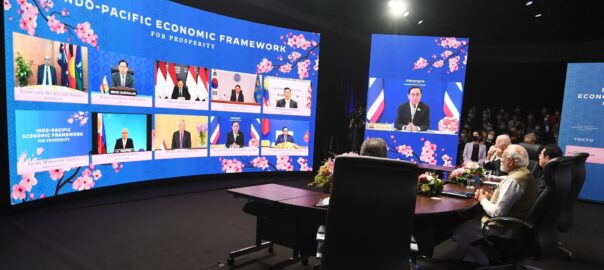
On May 23, the Joe Biden administration took a significant step to turn the clock back to the Obama Presidency by launching its own version of a “pivot to Asia” through the establishment of the Indo-Pacific Economic Framework for Prosperity (IPEF) with other partner countries — Australia, Brunei, India, Indonesia, Japan, the Republic of Korea, Malaysia, New Zealand, the Philippines, Singapore, Thailand, and Vietnam. Within days of its launch, IPEF expanded its membership to the Pacific Island states, with…
As has happened throughout the history of the multilateral trading system, agriculture remained mired in controversy in the run-up to the 12th WTO Ministerial Conference (MC12). The twice-postponed MC12 was expected to take several important decisions and to put the negotiations for reforming the Agreement on Agriculture (AoA) back on track, but over the past few weeks, the discussions among members have been excessively focused on two issues that are of critical importance for India.
By Kavaljit Singh | Briefing Paper # 53 | May 27, 2022
On May 23, U.S. President Joe Biden officially launched the Indo-Pacific Economic Framework for Prosperity (IPEF) in Tokyo. Conceived and led by the United States, the IPEF has 13 founding members, including Australia, Brunei, India, Indonesia, Japan, South Korea, Malaysia, New Zealand, the Philippines, Singapore, Thailand, and Vietnam. “The future of 21st century economy is going to largely be written in the Indo-Pacific…We are writing the new rules for 21st economy”, said Mr Biden at the launch event…
By Kavaljit Singh | Briefing Paper # 52 | April 5, 2022
On March 30, 2022, the International Monetary Fund published the Review of the Institutional View on the Liberalization and Management of Capital Flows. The review updates the IMF’s Institutional View (IV), adopted in November 2012, followed by guidance notes on capital flows added in April 2013 and December 2015. The IMF’s Institutional View is an important policy document because it provides an analytical framework for the Fund’s policy advice on liberalizing and managing capital flows.