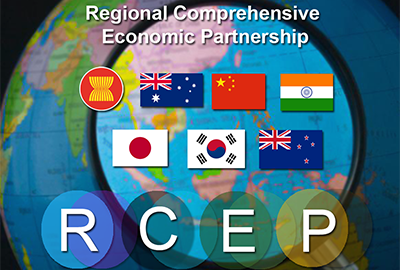
This e-pamphlet explains the proposed Regional Comprehensive Economic Partnership (RCEP), a mega-regional free trade agreement at the door of Asia Pacific, in easy-to-understand format. It outlines India’s current position on key elements of the proposed pact and highlights key sectoral concerns on agriculture, trade in goods and services, intellectual property, public health and investment protection. The e-pamphlet provides links to ‘leaked’ texts from the negotiations and a list of additional resources.
The background paper provides a critical analysis of the proposals made by the Development Assistance Committee (DAC) secretariat of the OECD in the paper titled, “Implementation of the Principles of ODA Modernization on Private Sector Instruments,” which is yet to be made public. The DAC’s proposals would allow a wide variety of private sector instruments to be used as vehicles for international aid. This means an increase in the possible use of aid to invest in or give loans…
By Kavaljit Singh | Briefing Paper # 18 | November 2016
In a major push to widen the scope of commodity derivatives market in India, Securities and Exchange Board of India (SEBI) has recently allowed options trading on commodity exchanges. This decision has been hailed by commodity exchanges as a game changer for Indian farmers. Tracing the experience of futures trading in the Indian commodity markets, the paper argues that the options trading is not suitable for Indian farmers as they lack the understanding, resources and capacities to trade in…
By Kavaljit Singh | Briefing Paper # 17 | July 2014
After operating in the shadows for more than two decades, the murky world of dark pools is coming into the light. On July 1, 2014, the Financial Industry Regulatory Authority (FINRA), independent securities regulator of the US, imposed a fine of $800,000 on Goldman Sachs for failing to ensure that trades in its dark pool trading system took place at the best price. Would an $800,000 fine on Goldman Sachs act as a deterrent to stop predatory behavior? The…
By Kavaljit Singh | Briefing Paper # 16 | June 2014
Since 2011, algo trading has been swiftly gaining ground in the Indian stock and commodity markets. Algorithmic trading is all the rage in India now but the key questions that are rarely asked: To what extent algo trading be allowed in the Indian equity and commodity futures markets? Do we have a system of checks and balances in place to control dysfunctional algorithms and minimise the possibilities of any flash crash?
Algorithmic trading is based on a technology-driven pre-programmed mathematical…
The view expressed in this blog are those of the authors and do not necessarily reflect the views of Madhyam. Madhyam welcomes and values your contributions to this blog. For further details, please contact us (madhyamblog@gmail.com).
We encourage you to communicate freely and openly about the themes covered in the blog.
You agree not to post any material that you do not have the right to post, for example, under intellectual property, confidentiality, privacy or other applicable laws.
You agree that your posted contributions will be licensed under the Creative Commons license applicable to comments where you post your material.
All comments will be moderated and published at the sole discretion of the Madhyam editorial team.
Madhyam reserves the right to delete, modify, refuse to post or remove (without notice or explanation) any Content, in whole or part, and to block any Contributor for any reason, at its sole discretion.
Madhyam also reserves the right to take any other action as may be appropriate in the circumstances.