
India-EU FTA: Assessing the “Mother of All Deals”
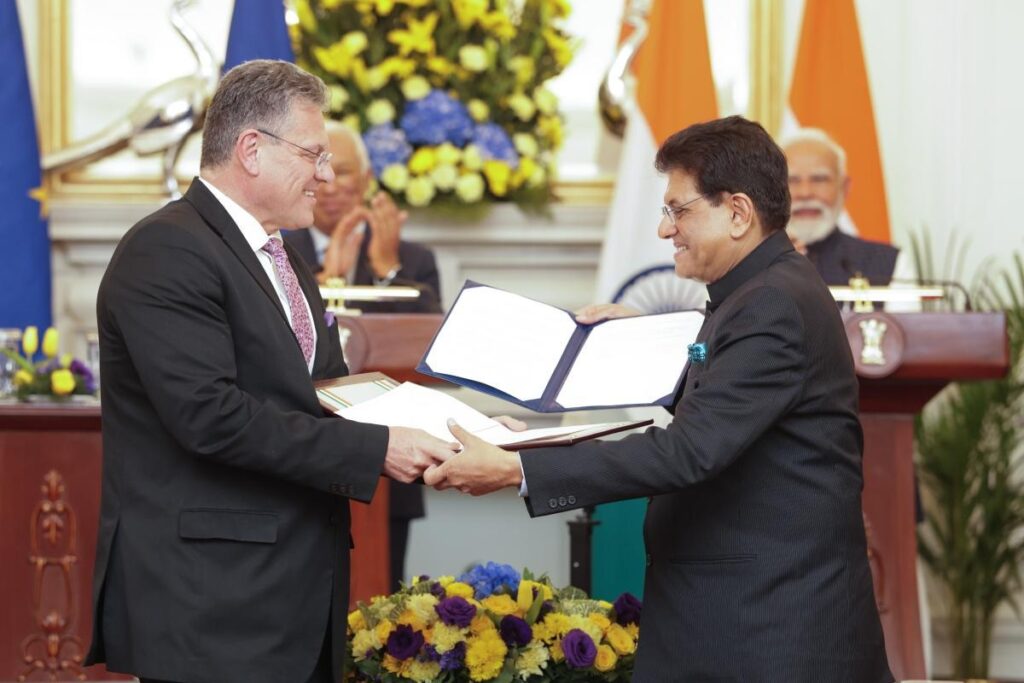
On 27th January this year, India and the EU concluded their free trade agreement (FTA) negotiations, the most protracted trade negotiations between two economies. It was at the 2005 EU-India Summit that the EU and India expressed “serious political commitment to increase bilateral trade and economic cooperation and to tackle barriers to trade and investment”[1] and both sides agreed to commence negotiations for such an agreement in 2006. Formal negotiations for the FTA began in 2007.
When the political decision to initiate FTA negotiations was taken, the EU was India’s largest trade partner with a 19% share in total trade and was also the largest export destination with a 22% share. In contrast, India was the EU’s 14th largest trade partner with a trade share of just 1% of total trade.[2] Both partners had several reasons to forge an FTA. India was looking to consolidate its position in its largest export market, which had considerably expanded with 10 countries having joined the bloc in 2024, its largest enlargement since formation.[3] India, on the other hand, was registering almost double-digit economic growth, in the period immediately preceding the “great recession” of 2008,[4] and its rapidly expanding market was, therefore, of significant interest to the EU.
Additionally, the EU recognised that India’s great advantage was its large pool of educated and skilled, English-speaking workers who offered a launch pad for service specialisation and also contributed to the growing consumer market.[5] Thus, the two trading partners took the decision to negotiate a broad-based trade and investment agreement, going beyond traditional free trade agreements that involved tariff-cutting exercises.
By agreeing to negotiate on “tariff-plus issues” in its FTA with the EU, India made a significant departure from its earlier held position to refuse inclusion of issues like investment, competition policy, transparency in government procurement and trade facilitation in a trade deal. India had refused to negotiate on these issues, the so-called “Singapore Issues”, in the World Trade Organization (WTO) ever since the advanced countries had proposed their inclusion in 1996.[6]
This paper discusses the negotiating dynamics of the EU-India FTA and analyses the implications of India’s commitments under the deal. At the outset, we need to point out that the details of the commitments are still not available, as the negotiating outcomes are in the process of being vetted by the Council of Europe and the European Parliament. The analysis presented in this paper is based on the assessments of the benefits from the FTAs available in the public domain, and the draft chapters containing the broad contours of provisions.
I. Initial Phase of Negotiations
The negotiations ran into rough weather soon after they commenced. The reason was India’s discomfiture over the inclusion of “Singapore Issues”, sustainable development and human rights, as well as the EU’s preference for ratcheting up the standards of intellectual property rights, the so-called “TRIPS-plus provisions”.[7] According to the EU, human rights was included in the FTA on account of the 1994 EU-India Cooperation Agreement on partnership and development, which “reaffirmed the importance the two governments attach[ed] to the principles of the United Nations Charter and the respect of democratic principles and human rights”, which, in turn, was linked to the issue of labour rights.[8] The EU emphasised that the FTA would “oblige both parties to implement the core labour standards of the International Labour Organisation in an effective way”.[9] Additionally, a European Parliament Resolution of 2011 emphasised that the FTA must “cover, as a minimum, compliance with the ILO’s eight core conventions and four priority conventions and internationally agreed environmental standards”.[10]
As regards the inclusion of TRIPS-plus provisions, the aforementioned European Parliament resolution was sympathetic to India’s concerns regarding the impact of such provisions on access to affordable medicines for its citizens. The resolution welcomed India’s “commitment to use TRIPS flexibilities in international and domestic legislation in order to meet its public health obligations, particularly in relation to access to essential medicines”. Furthermore, the European Parliament asked the “[European] Commission not to request data exclusivity in the context of IPR negotiations … and to recognise[d] that data exclusivity would have far-reaching consequences for the production of generic medicines and [was] therefore detrimental to developing countries’ access to medicines and public health policy”.
From the early stages of its negotiations with the EU, it was quite clear that India would have to accept commitments in several key areas, which it had refused to include in either bilateral or multilateral trade agreements. For instance, India had consistently opposed “any linkage between trade and labour standards” in the WTO,[11] but could not stand its ground in its FTA with the EU.
The early phase of negotiations made little progress until they were put on hold in 2013 with the two partners unable to resolve their differences over tariff reductions concerning several key products, including automobiles, intellectual property protection, data security and the right of Indian professionals to work in the common market[12]. With the change in the Central government in 2014, India developed an anti-FTA bias.[13]
An agreement with the EU on reviving the FTA negotiations was reached almost immediately after the pandemic.[14] The issue of market access was given priority, while negotiations on investment and geographical indications were moved to parallel tracks. Formal negotiations “on a balanced, ambitious, comprehensive and mutually beneficial free trade agreement” were revived in June 2022.[15] After 14 rounds of negotiations, the two trading partners agreed to conclude the FTA in January 2026. But agreements on investment and geographical indications are yet to be finalised.
II. Analysis of the EU-India FTA
The conclusion of the EU-India FTA negotiations set the stage for the formation of the world’s largest free trade zone between the second and the fourth largest economies, accounting for a quarter of the world’s population and GDP.[16] Though the two trading partners have agreed to the formation of the FTA, its implementation is still several months away as the EU’s internal legal procedures have to be gone through. The European Council and the European Parliament would have to endorse the draft text of the FTA before both trading partners put their signatures on the agreement, signalling its implementation. Thus, the draft texts (20 chapters and their annexes) have been published following the European Commission’s transparency policy, but most of the details of the commitments taken by the two partners, including the tariff commitments for goods and schedules of specific commitments in services, have not been disclosed. The basis for analysing the EU-India FTA would, therefore, be the assessments of both trading partners available in the public domain and a reading of the published chapters.
(i) Official Assessments by India and the EU
The Indian Government described the deal as a historic milestone in India–EU economic relations, emphasising that India and the EU are “trusted partners committed to open markets, predictability, and inclusive growth”.[17] According to the EU, the trade deal would “strengthen economic and political ties between the world’s second and fourth largest economies, at a time of rising geopolitical tensions and global economic challenges, highlighting their joint commitment to economic openness and rules-based trade”.[18]
Both trading partners are optimistic about the benefits from the FTA, especially at a time when the global economy is beset with uncertainties caused by President Donald Trump’s tariff war and the consequent dismantling of global trade rules. The escalating risk of trading with the US has forced major economies to explore ways of diversifying their export destinations. For both India and the EU, the newly minted FTA provides an opportunity to increase their bilateral trade, taking advantage of a negotiated set of rules.
India expects this FTA to increase its presence in one of its largest trade partners, as the EU has agreed to eliminate import tariffs on 99% of its imports from its new FTA partner in terms of trade value.[19] Several labour-intensive manufacturing sectors, including textiles and clothing, leather, footwear, marine products, and gems and jewellery, as well as engineering and automobiles, could be among the major beneficiaries as the EU has offered to remove import duties on these products. According to the Government of India, agricultural and processed food sectors could also receive “a transformative boost” under the India–EU FTA since commodities such as tea, coffee, spices, fresh fruits and vegetables, and processed foods could gain additional market access. One of the major pluses for India is that its FTA with the EU does not require it to reduce import duties on major cereals and dairy products. Thus, India has protected its sensitive agricultural products and has prevented its farming communities from facing adverse import competition.
Getting enhanced access for its service sectors has been among India’s key interests in bilateral trade deals. The EU seems to have met India’s expectations as it has opened up several sectors in which India has perceived strengths, including IT and IT-enabled services (ITeS), education, financial services, and other business sectors. The most notable gain for India in the services sector is the EU’s commitment to provide “seamless movement of skilled Indian professionals”, which was one of India’s key demands.
For the EU, its two-decade wait for clinching this bilateral trade deal seems to be well worth it as it has secured substantial concessions to increase its presence in the world’s 4th largest economy. India has offered to reduce or eliminate tariffs on almost 97% of its imports from the EU,[20] which could double the EU’s goods exports to India by 2032.[21] Included in India’s concessions is a reduction in tariffs on automobiles from 110% to 10%, but the EU’s exports would be regulated through an annual quota. The EU would consider this a major gain since India had refused to reduce its automobile tariffs on automobiles, which was one of the main reasons why the FTA negotiations could not be completed earlier. Other major sectors in which India has agreed to reduce and/or import duties include pharmaceuticals, processed agricultural products and wines, though in most cases, tariffs would be effectively reduced after 5-7 years. This transition period should stand the Indian industry in good stead, for it needs to improve its competitive strength.
Though the Indian government is quite upbeat about the prospects of benefiting from this deal stemming from the lower levels of tariffs offered by the new FTA partner, realisation of the expected benefits may not be easy as the EU uses a plethora of regulatory standards as non-tariff measures. Importantly, many of the key regulations are embedded in the FTA. We would briefly discuss a few aspects of the EU’s complex regulatory structure in the following section, which would allow a better understanding of the challenges that Indian businesses could face once the EU-India FTA is implemented.
(ii) The EU as a “Regulatory Superpower”
The EU has acquired the reputation as a “regulatory superpower” as it has been shaping global markets with its regulatory standards. Through “EU regulations are meant to protect consumers, uphold human dignity and promote an ethical form of capitalism”,[22] they also act as effective non-tariff measures. The EU has been adding to its inventory of regulatory standards as the single market has expanded and consolidated over the three decades of its existence. From its early days, the bloc was described as “Fortress Europe” for the manner in which the EU had adopted the “strategy of establishing one set of approved standards for certain products”.[23] The US, for instance, saw the EU standards as discriminating against its firms, keeping them out of the single market.
More than a decade ago, Anu Bradford labelled the EU’s penchant for standards, “The Brussels Effect”.[24] Bradford argued that Europe used “unilateral power to regulate global markets” by setting “global rules across a range of areas, such as food, chemicals, competition, and the protection of privacy”. The rules and regulations originating from Brussels, the author argued, “penetrated many aspects of economic life within and outside of Europe through the process of “unilateral regulatory globalization”.
Recently, BusinessEurope, a lobby group representing enterprises of all sizes in the European Union (EU) and seven non-EU European countries, made several startling revelations in its critical examination of the bloc’s regulatory framework.[25] Regulatory burdens were identified as one of the top two problems for businesses in Europe. More specifically, 68 pressing regulatory burdens were identified in 11 areas, which included energy and climate, consumer policy, international value chains and trade, digital economy, employment and social policy, and food law. These identified burdens were structured around 3 pillars of origin of disproportionate compliance costs, namely, (i) administrative burdens (including reporting requirements); (ii) excessive adjustment burdens; and (iii) cross-border regulatory barriers.
An initiative of the European Commission on the future of European competitiveness, prepared by the former President of the European Central Bank, Mario Draghi, also underlined that excessive regulatory burdens were adversely affecting the EU’s businesses.[26] The Draghi report recommended simplification of the regulatory environment, reducing regulatory burden and favouring speed and flexibility.[27]
Considering the formidable regulatory standards the EU employs, India’s ability to gain additional market access in the single market would depend on the ability of its businesses to comply with the web of standards the EU maintains, most of which have been included in the FTA.
(iii) Assessing the FTA from the Reading of the Draft Texts
As mentioned earlier, our assessment of the FTA is based on the information pertaining to the key areas that the two trading partners have put in the public domain.
(a) Broad Contours of Tariff Reduction in Goods
India’s market access gains are largely expected in labour-intensive sectors, though industries like automobiles, engineering goods and medical devices would also have opportunities to improve their presence in the world’s largest customs union. The EU has committed to eliminate tariffs on 70.4% of its tariff lines covering 90.7% of India’s exports, which could increase exports of textiles, leather and footwear, tea, coffee, spices, sports goods, toys, gems and jewellery and certain marine products. The largest industry, textiles and clothing, should be a big winner with opportunities for stepping up exports in yarn, cotton yarn, man-made fibre apparel, ready-made garments, men’s and women’s clothing and home textiles.
A further 20.3% tariff lines covering 2.9% of India’s exports would have the advantage of tariff-free access to the EU market over 3 and 5 years; the major beneficiaries are likely to be marine products and processed food items. Finally, 6.1% tariff lines covering 6% of India’s exports of certain poultry products, preserved vegetables, and bakery products would also benefit from tariff reduction. India’s automobiles, steel and some varieties of shrimps/ prawns products would gain from tariff rate quotas (TRQs) that the EU has agreed to introduce. The size of the TRQs has not been disclosed. At the other end of the technology spectrum, India’s medical instruments, appliances, and vital supplies should gain cost-competitive entry in the 27-member market. The EU has agreed to eliminate tariffs of up to 6.7% across 99.1% of trade lines, which should be to the advantage of lenses, spectacles, medical devices, measuring and testing instruments. However, sensitive European agricultural sectors such as sugar or rice have not been liberalised at all.
India has offered sizeable tariff cuts on its imports from the EU, lowering its tariffs on manufacturing goods to historically low levels. In fact, the tariff cuts offered to the EU are deeper than those in two of its larger FTAs concluded recently, namely, with the UK and the European Free Trade Association (EFTA). India’s tariff liberalisation is expected to deliver the following key benefits to the EU: (i) tariffs on over 90% of EU goods exports will be eliminated or reduced; (ii) saving up to €4 billion per year in duties, and (iii) competitive advantage for EU exporters, with biggest trade opening India has given to any trade partner.
But, as in all previous FTAs it has negotiated thus far, India has excluded from tariff cuts all sensitive agricultural commodities that are critical for the preservation of India’s food and livelihood security. Accordingly, cereals. dairy products, poultry, soymeal, certain fruits, and vegetables have been safeguarded.[28] India’s tariff cuts offered on several key products are shown in Tables 1 and 2.
Table 1: India’s Tariff Reductions in Agricultural and Meat Products
| Product | Current Tariffs | Future Tariffs |
| Wine | 150% | 20% (premium range); 30% (medium range) |
| Spirits | Up to 150% | 40% |
| Beer | 110% | 50% |
| Olive Oil, margarine, and other vegetable oils | Up to 45% | 0% |
| Kiwis and pears | 33% | 10% in-quota |
| Fruit juices and non-alcoholic beer | Up to 55% | 0% |
| Processed food (breads, pastries, biscuits, pasta, chocolate, pet food) | Up to 50% | 0% |
| Sheep meat | 33% | 0% |
| Sausages and other meat preparations | Up to 110% | 50% |
Table 2: India’s Tariff Reductions in Non-Agricultural Products
| Product | 2024 Exports (EUR) | Current Tariffs | Future Tariffs |
| Machinery and electrical equipment | €16.3 billion | Up to 44% | 0% for almost all products |
| Aircraft and spacecraft | €6.4 billion | Up to 11% | 0% for almost all products |
| Optical, medical, and surgical equipment | €3.4 billion | Up to 27,5% | 0% for 90% of the products |
| Plastics | €2.2 billion | Up to 16,5% | 0% for almost all products |
| Pearls, precious stones, and metals | €2.1 billion | Up to 22,5% | 0% for 20% of the products and tariff reduction for another 36% of the products |
| Chemicals | €3.2 billion | Up to 22% | 0% for almost all products |
| Motor vehicles | €1.6 billion | 110% | 10% (quota of 250,000 vehicles annually) |
| Iron and steel | €1.5 billon | Up to 22% | 0% for almost all products |
| Pharmaceuticals | €1.1 billion | 11% | 0% for almost all products |
Source for Tables 1 and 2: European Commission, Questions and answers on the EU-India Free Trade Agreement, January 27, 2026, accessed from: https://ec.europa.eu/commission/presscorner/detail/en/qanda_26_185.
However, India has opened its domestic market for processed agricultural products to the EU. Tariffs on processed food such as confectionery, breads, pastry, pasta, chocolates, pet food and sheep meat would be phased out over a period of time. For India’s fledgling food processing sector, which has received significant levels of government incentives in the post-COVID-19 phase, the entry of firms from the EU would be an unexpected challenge.
India has accepted the EU’s long-standing demand to reduce its tariffs on wines and spirits. While tariffs on the former would be reduced from 150% to 20-30%, depending on the quality, tariffs on spirits would now be 40% instead of 150%.
Among industrial products, India’s decision to lower tariffs on automobiles was a major gain for the EU. Tariffs on passenger cars have been extremely high, as recently as in 2022, 125% tariffs were imposed on completely built units. The EU has consistently argued for a reduction in tariffs and has been fully supported by the European Automobile Manufacturers’ Association (ACEA).[29] However, India’s automobile industry[30] was opposed to tariff cuts, arguing that the EU or the US continued to keep automobile tariffs high wherever they have sensitivities, and, therefore, a relatively young Indian automobile industry was fully entitled to receive tariff protection.[31] Eventually, the EU’s demand for reducing tariffs to 10%[32] tabled at an early stage in the negotiations was agreed to while concluding the deal, with an additional condition that India would import no more than 250,000 annually from the EU.
(b) Market Access for Services
The services chapter of the FTA provides enhanced opportunities for both the EU and Indian services suppliers to expand bilateral trade in a more stable and predictable trade environment. The agreed rules include two sets of provisions that India had not accepted while implementing the General Agreement on Trade in Services (GATS) of the WTO. These provisions are incorporated from other FTAs being implemented by the EU. The first of these is the inclusion of a framework like the Understanding on Commitments in Financial Services (the “Understanding”), which rejects the “positive list” approach of the GATS, wherein WTO members, including India, offer sectors for liberalisation in keeping with their ability to do so.[33] The “Understanding” inverts this approach, making members accept all the listed commitments unless they indicate specific exception(s). Seeking such exceptions is usually a tall ask for developing countries engaged in negotiations with an advanced country partner. Secondly, India has agreed to incorporate and implement most of the rules agreed under the WTO Domestic Regulation Joint Statement Initiative (JSI), of which India is not a member. This is a major compromise on India’s part, as it has consistently spoken against the JSIs in the WTO.[34] These JSIs have seen subsets of WTO members agreeing to negotiate among themselves on issues that are of their interest, without any prior discussion amongst the entire membership of the organization.[35] India has argued that new issues can be taken up for negotiations in the WTO only when there is consensus among the membership for doing so.
India’s specific benefits in the services sector would stem from the EU’s broader and deeper commitments across 144 services subsectors, including IT/ITeS, professional services, education, and other business services. In this broad range of services sectors, Indian service providers should get a stable and predictable regime in the single market to expand their services.
The FTA includes an assured regime for temporary entry and stays for professionals, one of India’s key demands in the FTA negotiations. This would potentially benefit Business Visitors, Intra-Corporate Transferees, Contractual Service Suppliers, and Independent Professionals. Furthermore, independent professionals intending to provide services to EU clients would get policy certainty in 17 sub-sectors, the most important among these are IT, R&D, and higher education. This could create additional opportunities for Indian professionals and knowledge-driven trade. The FTA partners have also agreed to enable Social Security Agreements in 5 years with all the EU Member States and would work towards a conducive framework for the entry of Indian students to study and avail post study work visa.
(c) Digital Trade
The EU-India FTA is only its second FTA, after the FTA with the UK, in which India has accepted commitments on digital trade. Two issues need to be highlighted about India’s decision to accept commitments on digital trade in its FTA with the EU. First, India has been reluctant to cede its policy space in this critical area and had opposed the JSI on Electronic Commerce, the Agreement on Electronic Commerce that is now in place. Secondly, the EU has reported after the conclusion of the EU-India FTA negotiations that the Chapter on Digital Trade “integrates the majority of the rules agreed under WTO Electronic Commerce Joint Initiative, of which India is not a member”. This JSI is a commitment by the signatory states that they will not impose customs duties on electronic transmissions. India, on the other hand, has been vocal about its right to impose customs duties on electronic transmissions and was opposing the e-commerce moratorium that prevented WTO members from imposing duties on electronic transmissions.[36]
The objective of the chapter on Digital Trade in the EU-India FTA is “to facilitate digital trade, to address unjustified barriers to trade enabled by electronic means and to ensure an open, secure and trustworthy online environment for businesses and consumers”. The provisions of this chapter that are available in the public domain would not prevent India from using customs duties on electronic transmissions, which has been its clearly stated position. But since the objective of the chapter is to “ensure an open, secure and trustworthy online environment for businesses and consumers”, there are doubts as to whether India would be able to defend its right to impose customs duties on digital transmissions, and to also insist on data localisation, or preventing transboundary data flows. In other words, several facets of India’s digital policy would be tested once its FTA with the EU is implemented.
(d) The EU’s Regulatory Standards
We had mentioned in an earlier section that India expects the FTA to help increase its exports of agricultural and marine products, whose share was just more than 7% of India’s total exports to the EU in 2024-25. In the same year, India’s total exports of agricultural and marine products were over 12% of the total exports, which implies that there is potential for increasing exports to the EU.
Though India expects that the FTA would help in increasing agricultural exports, conformity with the EU’s strict food safety standards could be a formidable challenge. The EU has explicitly stated that human, animal, and plant health is not negotiable and that all products imported from India under the agreement will have to respect these standards.[37] The EU has emphasised that its members follow very stringent, science-based standards to protect human, animal, and plant health and that all products imported from India under the agreement would have to respect these standards. The Chapter on SPS Measures specifies that India’s exports of agriculture and food products to the EU would have to comply with importing countries’ strict SPS rules, with no exception.
Thus, the EU-India FTA Chapter on sanitary and phytosanitary measures insists on higher transparency and predictability when trade of plant and animal products, including fisheries/aquaculture products, is involved. These standards would be enforced using clear timelines and mechanisms for important procedures such as import conditions and approvals.
The chapter on Trade and Sustainable Development (TSD) included in the Agreement introduces two sets of regulations, those that are intended to enhance environmental protection and adequate protection of workers’ rights. The EU has always favoured a significant reduction of the carbon footprint, and for so doing, it has adopted strict domestic standards on emissions. From earlier this year, the EU has imposed the Carbon Border Adjustment Mechanism (CBAM), which is a carbon tax imposed at the border on imports. CBAM would increase the compliance costs as Indian exporters would have to meet the exacting emission norms before they can enter the EU market. The only silver lining is that the EU has offered to extend to India some concessions that it had earlier provided to the US.
In all its FTAs, the EU has insisted that its partner countries commit to promote development of trade in a way that is conducive to decent work for all,[38] as expressed in the ILO Declaration on Social Justice for a Fair Globalization of 2008. In specific terms, the Chapter on TSD would require India to ratify the fundamental ILO Conventions that guarantee effective protection to workers’ rights. India has not ratified two of the key conventions, on freedom of association and the right to collective bargaining, essentially to lend more flexibility to the implementation of labour laws. This requirement to bring India’s newly enacted labour codes into conformity with the internationally accepted labour standards could become a major issue while India implements its FTA with the EU.
(e) Intellectual property rights
Implementation of a high level of protection and enforcement of intellectual property rights was one of the EU’s major demands. Among the EU’s demands was that India must protect new plant varieties using the provisions of the UPOV Convention, which prevents farmers from saving seeds from one harvest and re-using them in the next. India has in place its own legislation that allows farmers to save their seeds and also protects new plant varieties developed by the farmers. The question is whether the EU would allow this legislation to stand in its present form.
The Chapter on Intellectual Property currently has no provisions on patent rights. This is surprising as in two of the earlier FTAs, with the European Free Trade Association and the UK, India had accepted the demands from its FTA partners to amend the Patents Act. Provisions relating to pre-grant opposition and grant of compulsory licences were diluted, both of which are critical for ensuring access to affordable medicines. We had mentioned in an earlier section that in the first phase of negotiations, the European Parliament had agreed not to insist on changes in the intellectual property laws that could affect access to affordable medicines in India. Would the European Parliament express similar sentiments now?
(iv) Towards the Final Agreement
At the end of January 2026, the European Union and India announced the conclusion of their 19-year-long negotiations for their bilateral FTA. The implementation of the agreement would have to wait until the Council of Europe reviews it and the European Parliament completes the process of ratification. Both partners expect the deal to significantly increase their two-way trade, which would stand their economies in good stead during the ongoing economic uncertainties.
However, for India’s expectations to be realised, its business houses would have to prepare themselves for complying with the plethora of regulatory standards that the EU has included in the FTA. In most advanced economies, tariffs are almost passé; the EU’s average trade-weighted tariff across all products was 2.8% in 2024,[39] though there are some peak tariffs in agriculture, applied on 2% of all agricultural tariff lines. Since the turn of the millennium, tariffs have given way to non-tariff measures (NTMs) as instruments of trade protection. NTMs affect nearly 90% of global trade by volume, and are six times more significant than they were three decades ago.[40] In other words, the EU is following the global trend in the use of regulatory standards.
It seems quite clear that India needs to adequately prepare itself to realise the projected gains from the FTA. Indian businesses have so far failed to increase their exports in all the previous FTAs with major economies, causing trade deficits to consistently increase. India needs to avoid this dubious record while implementing what the EU President Ursula von der Leyen described as the “mother of all deals”.[41]
Notes and References
[1] Report of the EU-India High Level Trade Group to the EU-India Summit, October 13, 2006.
[2] European Parliament, EU-India FTA, February 2, 2026, accessed from: https://www.europarl.europa.eu/legislative-train/theme-a-global-europe-leveraging-our-power-and-partnerships/file-eu-india-fta-bit-and-gi-agreement.
[3] EU, EU Enlargement, n.d., accessed from: https://european-union.europa.eu/principles-countries-history/eu-enlargement_en.
[4] Between 2003-04 and 2007-08, the average growth rate of the Indian economy was almost 9%. See, Economic Survey 2009-10, Finance Ministry, Government of India, 2010, Table 1.2, p. A4.
[5] Report of the EU-India High Level Trade Group to the EU-India Summit, October 13, 2006.
[6] These four issues were included in the work programme of the WTO at the First Ministerial Conference in Singapore (1996) at the insistence of the advanced countries. However, most developing countries, including India, refused to include new issues in the WTO. See, Dhar, Biswajit, Doha: A Developing Country Perspective, Economic and Political Weekly, Vol. 36, No. 46/47 (November 24-30, 2001), pp. 4343-4345.
[7] European Parliament, Delegation for relations with India (D-IN): Summary of activities during the 2009-2014 parliamentary term, n.d., accessed from: https://www.europarl.europa.eu/cmsdata/290219/Summary%20of%20D-IN%20delegation%20activities%202009-2014.pdf.
[8] Cooperation Agreement between the European Community and the Republic of India on partnership and development, Official Journal of the European Communities, No L 223/24, 27. 8. 1994, accessed from: https://eur-lex.europa.eu/legal-content/EN/TXT/PDF/?uri=CELEX:21994A0827(01).
[9] European Parliament, Delegation for relations with India (D-IN): Summary of activities during the 2009-2014 parliamentary term, n.d., accessed from: https://www.europarl.europa.eu/cmsdata/290219/Summary%20of%20D-IN%20delegation%20activities%202009-2014.pdf.
[10] European Parliament, Free trade agreement with India: European Parliament resolution of 11 May 2011 on the state of play in the EU-India Free Trade Agreement negotiations, (2012/C 377 E/03), 2011, accessed from: https://eur-lex.europa.eu/legal-content/LT/ALL/?uri=CELEX:52011IP0224.
[11] WTO, India: Statement by the Honourable Murasoli Maran – Minister of Commerce and Industry, Ministerial Conference: Fourth Session, Doha, November 10, 2001, accessed from: https://www.wto.org/english/thewto_e/minist_e/min01_e/statements_e/st10.pdf.
[12] Emmott, Robin, EU and India to revive stalled trade talks, draft statement says, May 4, 2021, accessed from: https://shorturl.at/PgfQN.
[13] Dhar, Biswajit, Analysing India’s FTA Policy Shifts, Commentary, Madhyam, June 5, 2024, accessed from: https://www.madhyam.org.in/analysing-indias-fta-policy-shifts/.
[14] Ministry of External Affairs, Joint Statement on India-EU Leaders’ Meeting, May 8, 2021, accessed from: https://www.mea.gov.in/bilateral-documents.htm?dtl/33853/Joint_Statement_on_IndiaEU_Leaders_Meeting_May_08_2021.
[15] European Parliament, EU- India FTA, March 2026, accessed from: https://www.europarl.europa.eu/legislative-train/theme-a-global-europe-leveraging-our-power-and-partnerships/file-eu-india-fta-bit-and-gi-agreement.
[16] European Commission, The EU-India trade agreement, 2026, accessed from: https://commission.europa.eu/topics/trade/eu-india-trade-agreement_en.
[17] PIB, India–EU Free Trade Agreement Concluded: A Strategic Breakthrough in India’s Global Trade Engagement, January 27, 2026, accessed from: https://www.pib.gov.in/PressReleasePage.aspx?PRID=2219065®=3&lang=1&v=3.
[18] European Commission, EU and India conclude negotiations for largest trade deal in their history, January 28, 2026, accessed from: https://ec.europa.eu/commission/presscorner/detail/en/ac_26_253.
[19] This assessment is based on the Government of India’s press release immediately following the conclusion of the deal. See, PIB, India-EU Free Trade Agreement Concluded: A Strategic Breakthrough in India’s Global Trade Engagement, January 27, 2026, accessed from: https://www.pib.gov.in/PressReleasePage.aspx?PRID=2219065®=3&lang=1&v=3.
[20] This discussion is based on the European Commission’s assessment of the trade deal. See, European Commission, EU–India Free Trade Agreement Concluded: Major Global Trade Milestone. January 29, 2026, accessed from: https://ec.europa.eu/commission/presscorner/detail/en/ac_26_253.
[21] European Commission, EU and India conclude landmark Free Trade Agreement, January 27, 2026, accessed from: https://ec.europa.eu/commission/presscorner/api/files/document/print/en/ip_26_184/IP_26_184_EN.pdf.
[22] Israel, Karl-Friedrich, Is the EU weaponizing standards?, October 30, 2025, accessed from: https://www.gisreportsonline.com/r/eu-regulatory-protectionism/.
[23] Chapman, Peter, War of words over ‘fortress Europe’ hots up. Politico, December 9, 1998, accessed from: https://www.politico.eu/article/war-of-words-over-fortress-europe-hots-up/.
[24] Bradford, Anu, The Brussels Effect, 107 NW. U. L. REV. 1 (2012), 2012, accessed from: https://scholarship.law.columbia.edu/faculty_scholarship/271.
[25] BusinessEurope, Reducing Regulatory Burden to Restore the EU’s Competitive Edge, January 2025, accessed from: https://www.businesseurope.eu/wp-content/uploads/2025/02/2025-01-22_businesseurope_mapping_of_regulatory_burden-d55-1.pdf.
[26] European Commission, The future of European competitiveness, September 2024, accessed from: https://commission.europa.eu/topics/competitiveness/draghi-report_en.
[27] European Commission, A Competitiveness Compass for the EU, COM(2025)30 final, January 29, 2025, accessed from: https://eur-lex.europa.eu/legal-content/EN/TXT/?uri=CELEX%3A52025DC0030.
[28] See, PIB, Factsheet: India and European Union Trade Agreement, January 27, 2026, accessed from: https://www.commerce.gov.in/wp-content/uploads/2026/01/Factsheet-on-India-EU-trade-deal-27.1.2026.pdf.
[29] ACEA, EU-India FTA negotiations: Automobile industry perspective, February 2015, accessed from: https://www.europarl.europa.eu/meetdocs/2014_2019/documents/d-in/dv/0211_04/0211_04en.pdf.
[30] Society of Indian Automobile Manufacturers.
[31] SIAM, White Paper: India’s Free Trade Agreements SIAM Position and Rationale, 2013.
[32] Škoba, Laine, Controversial issues in EU-India trade Disputes at WTO level, European Parliamentary Research Service, April 25, 2014, accessed from: https://www.europarl.europa.eu/RegData/bibliotheque/briefing/2014/130597/LDM_BRI(2014)130597_REV1_EN.pdf.
[33] Parlin, C. Christopher, Current Developments Regarding the WTO Financial Services Agreement, in IMF. Current Developments in Monetary and Financial Law. Volume 3, April 29, 2005, accessed from: https://www.imf.org/external/pubs/nft/2005/cdmf/index.htm.
[34] At WTO’s 11th Ministerial Conference in 2017, groups of WTO members issued joint statements on initiating discussions on e-commerce, investment facilitation for development (IFD), on micro, small and medium-sized enterprises (MSMEs) and on domestic regulation in services trade. Negotiations on two JSIs, e-commerce and IFD, have been completed.
[35] WTO, The Legal Status of ‘Joint Statement Initiatives’ and their Negotiated Outcomes, WT/GC/W/819/Rev.1, April 30, 2021, accessed from: https://docs.wto.org/dol2fe/Pages/SS/directdoc.aspx?filename=q:/WT/GC/W819R1.pdf&Open=True.
[36] The moratorium was introduced at the end of the Second WTO Ministerial Conference in 1998. See, WTO, Declaration on Global Electronic Commerce, Adopted on 20 May 1998, WT/MIN(98)/DEC/2, May 25, 1998, accessed from: https://www.wto.org/english/tratop_e/ecom_e/mindec1_e.htm .
[37] European Commission, Factsheet – EU-India Free Trade Agreement: EU agrifood exports, 2026, accessed from: https://policy.trade.ec.europa.eu/eu-trade-relationships-country-and-region/countries-and-regions/india/eu-india-agreements/factsheet-eu-india-free-trade-agreement-eu-agri-food-exports_en.
[38] Decent work means “opportunities for everyone to get work that is productive and delivers a fair income, security in the workplace and social protection for families, better prospects for personal development and social integration”, and is the core of SDG8.
[39] WTO, World Tariff Profiles 2025, 2025, accessed from: https://www.wto.org/english/res_e/booksp_e/world_tariff_profiles25_e.pdf.
[40] Gill, Indermit, The biggest drag on global trade isn’t tariffs, but standards, The Economist, January 22, 2026.
[41] European Commission, EU and India conclude negotiations for largest trade deal in their history, January 28, 2026, accessed from: https://ec.europa.eu/commission/presscorner/detail/en/ac_26_253.
Biswajit Dhar is a Development Economist and a former Professor at Jawaharlal Nehru University, New Delhi.
Image courtesy of European Union (2026, licensed under CC BY 4.0)