
The “Trump Round” of Trade Talks Through 2025
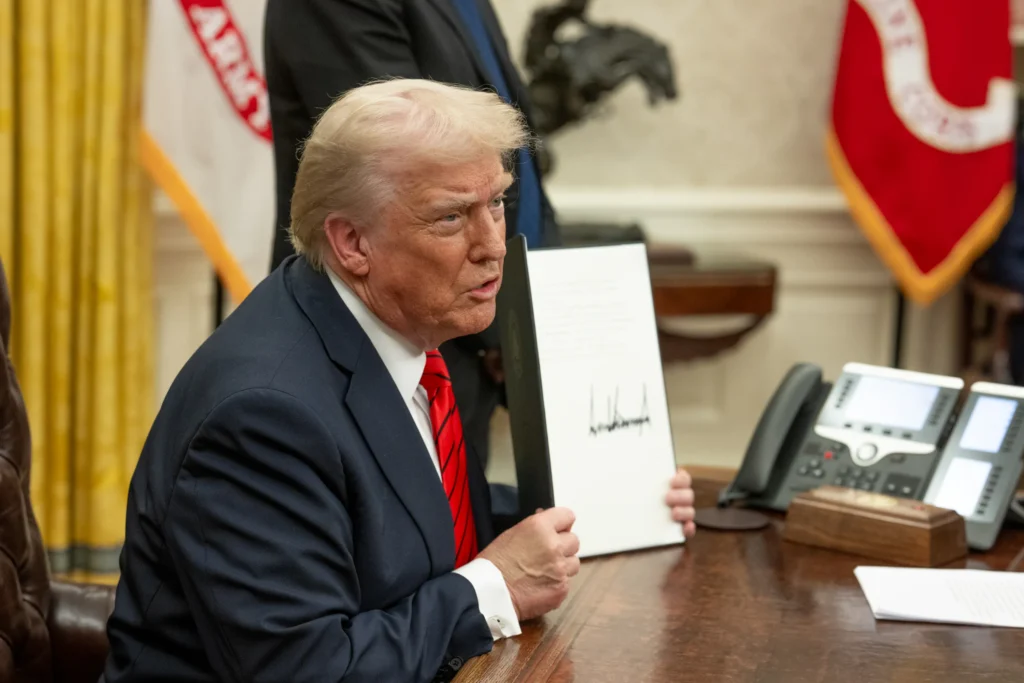
As 2025 draws to a close, it is plain to see that the year has been marked by US President Trump singularly undertaking a round of bilateral trade talks with several countries across the world. It is important to consider how his modus operandi tramples on democratic processes and principles in the United States. It can be argued that unilateral decision-making by the USA has been ongoing before and even after multilateral fora such as the World Trade Organization (WTO) were established. The USA routinely uses the provisions of its Trade Act of 1974 to blacklist what it considers unfavourable trading partners. The USTR’s Office annually prepares a Special 301 Report on countries with supposed weak intellectual property (IP) protection and enforcement; India is routinely put on its ‘Priority Watch List’. This is despite the WTO flexibilities that allow sui generis options for developing countries on the issue of IP. Trump’s unhinged unilateralism under his “America First Trade Policy” is perhaps unprecedented in US history.
Domestic Legislation Ignored
Trump’s decision-making on tariffs clearly shows the importance of having checks and balances on the exercise of executive power. He argues that the US International Emergency Economic Powers Act (IEEPA) allows him to impose tariffs in such a manner. However, his interpretation of that law, the IEEPA, has been legally challenged in the USA. On 29 August 2025, the US Court of Appeals for the Federal Circuit ruled the reciprocal tariffs illegal. In a majority opinion (7-4), it confirmed the decision by the US Court of International Trade (CIT) delivered on 28 May 2025 that the President had exceeded his authority in imposing tariffs under the IEEPA.
The amici curiae filed in the matter were motivated to defend the “enduring constitutional principle that Congress alone holds the power to impose tariffs, and that the President may act only pursuant to a valid, limited delegation of authority consistent with Article I (of the Constitution of the USA).”
The Trump administration appealed to the Supreme Court (SC) of the USA. On 9 September 2025, the SC allowed a writ of certiorari and a motion to expedite the matter before it. The SC scheduled oral arguments in early November 2025. The Supreme Court’s decision is awaited. It is likely to be announced only next year after the Court resumes work in January 2026.
Countering the presidential executive order is made possible by domestic laws and constitutional safeguards on which to base the challenge. This is critical in dealing with the overreach of the executive branch.
In India, for instance, the Foreign Trade (Development and Regulation) Act, 1992, was legislated when its economy was being liberalised. It does not grant the government any emergency economic powers. In addition, it requires every rule and order made by the Central Government under this Act to be laid, as soon as possible after it is made, before each House of Parliament [vide Section 19(3)]. The Constitution of India envisages three types of emergencies: national emergency (Article 352), state emergency (Article 356), and financial emergency (Article 360). In any such case, the President is to exercise power within carefully prescribed limits. These must be considered when responding to the US.
Appropriate Venues Sidelined
The venues of decision-making on vital subjects, such as trade policies, determine how wider public consultation can occur.
The US has also been blocking appointments of appellate body members of the Dispute Settlement Body at the WTO, thereby paralysing its functioning. Such sidelining of established rules of international law and appropriate venues for resolving trade disputes is unwarranted and unacceptable. It forecloses the possibility of legitimate stakeholders being involved in inter-country processes.
At the intra-country level, creating a conducive space for reviewing executive decisions is equally critical. Under the UK’s Constitutional Reform and Governance (CRAG) Act, any free trade agreement (FTA) must be placed before parliament for scrutiny before it is ratified. In Australia, following the signature of an FTA by the relevant officials, treaties are to be tabled in both Houses of Parliament for consideration by the Joint Standing Committee on Treaties (JSCOT).
India’s own Constitutional Article 253 gives Parliament the power to make laws on any treaty, agreement, or convention with other countries. After the executive act of signing a treaty, the decision to ratify it is not brought to the Parliament. However, a Joint Parliamentary Committee could examine the implications of a trade agreement. Any new FTAs proposed and signed by India must be discussed in the Parliament of India.
Conclusion
Executive excess and erosion of legislative authority should be a matter of grave concern for democracies. As the amici argue, it is essential to reaffirm that, in a republic, the process cannot be subordinated to expediency. Structural safeguards for democratic accountability should be followed beyond trade and commerce issues.
Countries committed to democratic decision-making need to be watchful of the unintended consequences of the ‘Trump Round’ of trade talks. One that turns inter-country relations and the WTO into the World Trump (re)Order-isation.
Shalini Bhutani is a Delhi-based law researcher and public policy analyst specialising in trade issues.
Image courtesy of The White House (www.whitehouse.gov).